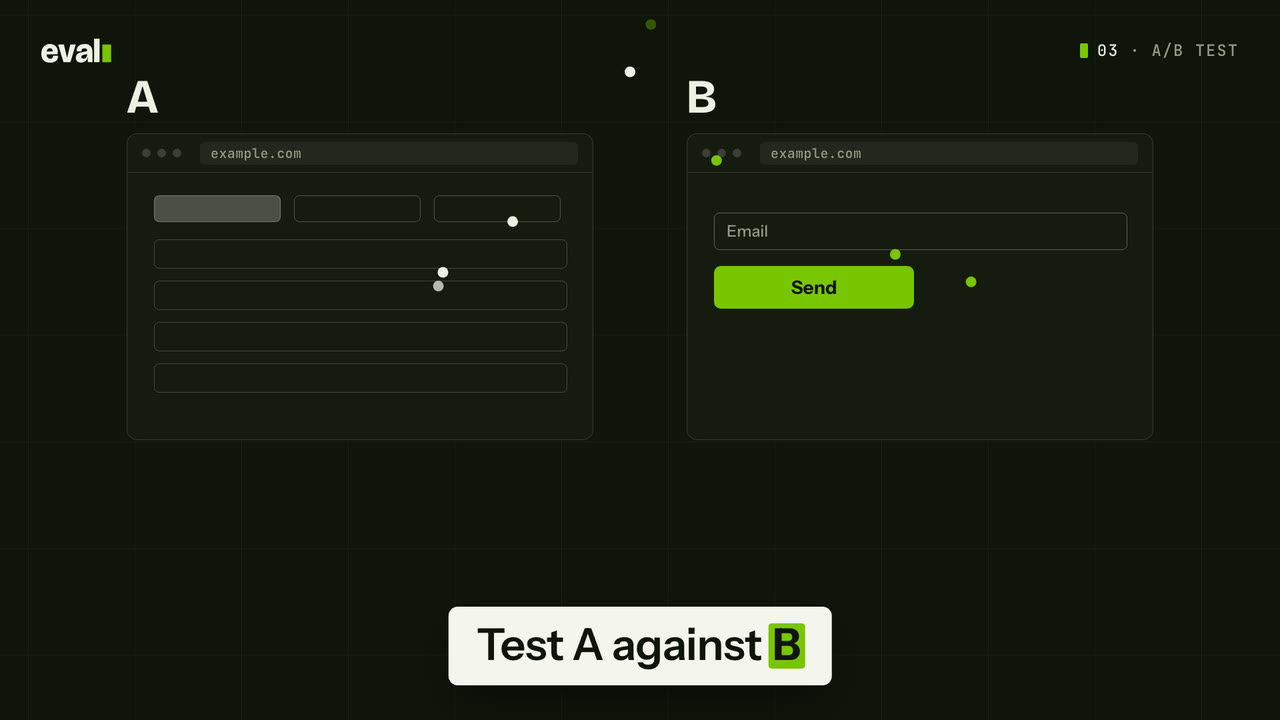
Conversion rate optimization (CRO) aims to get more of your website’s visitors to do what the site exists for: request a quote, buy, sign up. We find where visitors get stuck, form hypotheses, and let testing decide what works better.
A hundred visitors arrive. Few get in touch. Where do the rest go? We read the data, find where people drop off, and form a hypothesis. Then we test it, version A against version B, and keep what wins. The goal: more inquiries from the same traffic. CRO by Eval.
Because getting the traffic is the expensive part. If two out of a hundred visitors contact you and you raise that to three, you get one and a half times as many inquiries for the same ad spend and the same SEO work. That is why conversion optimization nearly always comes before “let’s bring in more visitors.”
Measurement instead of opinion
Everyone has an opinion about a website: the owner, the marketer, the designer. The point of conversion optimization is that the argument is not settled by the loudest opinion but by what visitors do.
So every change starts as a hypothesis: “If we shorten the form from three steps to one, more people will complete it, because most visitors now leave at step two.” Then we test it. If it holds, it stays. If not, we have learned something, and we have not damaged the site on a hunch.
What we examine
Clarity: is it obvious within five seconds what the page offers, and to whom?
Relevance: does the visitor find what they came for?
Trust: is there enough evidence to hand over contact details or pay?
Friction: how many fields, steps and clicks do we ask for without need?
Speed and mobile experience: is the technology losing the visitor before the content gets a chance?
Does it make sense with low traffic?
Yes, just differently. A classic A/B test needs many visitors, but the places where visitors get stuck can be found and fixed at lower traffic too. The Academy explains exactly how: A/B testing on a low-traffic website.
If the starting point is still missing, meaning there is no page worth sending traffic to, a landing page should come first.
01/What you get
What you get
01
Measurement foundations put right: what counts as a conversion, and whether it is tracked reliably
02
Funnel analysis: the step where you lose the most visitors
03
An expert review of your key pages, on mobile and desktop
04
A ranked list of hypotheses: what is worth changing, and why
05
A/B tests designed, built and evaluated, where traffic allows
06
A readable summary: what we learned, what stays live, what comes next
02/Process
How we work
01
Measurement
We check whether the data can be trusted. Good decisions cannot be built on bad tracking.
02
Diagnosis
We find where and why visitors get stuck: from data, from reviewing the site, and from customer feedback if you have it.
03
Hypothesis and test
We test the most promising changes: one visitor sees the old version, the next sees the new one.
04
Decision
The winner stays, and the lesson goes into the plan for the next round.
03/Frequently asked questions
Frequently asked questions
How much traffic does A/B testing need?
More than most people think. If a page produces only a few dozen conversions a month, a classic A/B test will not give a reliable result for months. In that case we work with other methods: bigger, bolder changes, measuring earlier funnel steps, expert review. We tell you this honestly before quoting.
By how much will my conversion rate go up?
Nobody can say in advance, and anyone who promises a number is guessing. What we can commit to is introducing changes in a measurable way, so you will know what helped and what did not.
Does the website have to be rebuilt?
Usually not. Most results come from targeted changes to a few key pages (homepage, product or service page, form, cart). If the site’s foundations get in the way of the work, we will flag it.
What experience do you have with this?
Our founder spent ten years leading product for the US market, where A/B and multivariate testing were part of everyday decision-making on a product serving more than 30 million registered users.
On most small-business websites a classic A/B test never ends with a meaningful result. Here is the simple arithmetic that shows why, and five methods that work with low traffic.